Trump as pope, the Obamas as monkeys, and a hospital ship bound for Greenland: Artificial intelligence challenges our relationship with truth
President Trump’s use of AI-manipulated images and videos is drawing attention. The lifelike images challenge the brain, experts say.
By Minna Skau reporting from the USA
https://www.kristeligt-dagblad.dk/
Read the news story in Danish here
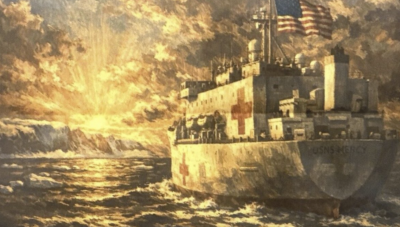 In a post on Truth Social, the President of the United States, Donald Trump, shared this AI-generated image of a hospital ship flying an American flag, heading toward a sunset. The accompanying text said that the ship is to care for sick people in Greenland. Photo: Screenshot from a Truth Social post.
It didn’t take many hours after the United States’ arrest of Venezuela’s president, Nicolás Maduro, on January 3 of this year before President Donald Trump shared an image of the captured Maduro wearing a gray tracksuit, handcuffs, and a blindfold aboard a U.S. warship.
Soon afterward, many other images and videos appeared on social media: Maduro with blood on his shirt, Maduro in an orange prison jumpsuit, Maduro with a sack over his head, Maduro in court, and half-naked Venezuelans cheering in a mass celebration in the streets.
Trump’s first image was real. The others were created with the help of artificial intelligence (AI) as pure fiction or built on entirely different events — the one with the sack is actually the former dictator Saddam Hussein in Iraq, and the cheering crowd comes from an annual underwear run at an American university.
At other times, the U.S. president has also shared fully or partly fabricated images.
There has been one of himself as the Catholic pope. In a video he was a pilot in a bomber plane dropping feces on a demonstration against him. Recently he shared another video containing a cartoon-like sequence of former President Barack Obama and his wife as monkeys. And over the weekend it was an image of an American hospital ship on its way to Greenland.
All of that is fairly easy to see through. But recently Trump crossed a new line when the White House shared an AI-manipulated image that claimed to show the arrest of the Black civil-rights attorney Nekima Levy Armstrong in connection with an action supporting immigrants in a church in Minneapolis, Minnesota.
In the real image, a composed Armstrong is led away by police. In the manipulated image, her skin has been made darker, and her entire face is wet and distorted by what appears to be uncontrolled crying.
Hard to “un-see” an image
In that situation, it can be almost impossible to distinguish between real and fake images. The lifelike images challenge the brain, says assistant professor Sandra Ristovska, an expert in visual evidence in court at the University of Boulder, Colorado.
“It lies deep in human nature and in the way we see and interpret images that it can be difficult to ‘un-see’ an image or a video once we have seen it. If we hear testimony, we know it is another person’s version of reality. But when we see a video, we get the experience that we ourselves are seeing the event firsthand,” says Sandra Ristovska.
She refers to the concept of the “liar’s dividend,” where the goal is not necessarily to make people believe a lie, but just as much to make them doubt the truth. And she says it is especially challenging when the U.S. president and government also share the manipulated version of reality.
Professor of communication Renee Hobbs at the University of Rhode Island says it is natural to react to constant doubt and uncertainty by shrinking back, stopping following the news, and caring less about what is true and false.
“It’s hard when so many unreal realities are fluttering past us. And if we become indifferent to whether something is true or false, we risk losing many of the cooperative structures that make civilization possible. It affects all the different circles of our relationships with neighbors, friends, colleagues, and ultimately in society,” says Renee Hobbs.
We have not lost the truth
But both she and Sandra Ristovska find comfort and hope in history. Both express that they do not believe truth as a shared concept has been lost — even though AI is indeed a serious challenge.
“I understand that the technology is now far more sophisticated than ever. But the fact that we repeat earlier eras’ fears and utopian — yes, dystopian — scenarios tells us that it has never been easy to fight for truth collectively. But we have always found ways to do it,” says Sandra Ristovska.
She emphasizes the importance of institutions such as the media, courts, and authorities adapting their practices to handle and verify visual information. As before, one witness statement is not enough in court, and one eyewitness account is not enough for responsible media.
The recent challenge from Minneapolis, where AI-produced material created doubt about the sequence of events surrounding immigration authorities’ killing of the activists Renee Good and Alex Pretti, is a good example that people are not, after all, so easily deceived.
“Despite the many AI-generated images of the shooting incident, it did not greatly influence or change the public’s perception. Most people saw the real video recordings, discussed them, and concluded that the officers had acted unjustly. It still matters to be held publicly accountable. We have not lost the truth,” says Ristovska.
Renee Hobbs assesses that people are continually capable of relearning how we read images.
“Strictly speaking, we are still only in the first phase of adapting to social media and a new way of communicating. Media literacy is, in itself, a very hopeful field, because it shows us how we can learn our way out of the challenges. We can minimize risk and harm, and we can maximize some of the creative gains of AI technology. It is us who build the system, based on how we use it,” says Hobbs.
She draws a parallel all the way back to the Greek philosopher Plato, who lived about 300 years before the birth of Christ:
“Plato was worried that people would lose their memory when we began writing things down. He was right about that. But then we adapted. It’s good to remind ourselves that human beings have always found a way forward.”
Comments(0)