Who Benefits? K-pop Demon Hunters and the Media Ecosystem
By Sejin Kim
Who benefited from the popularity of K-pop Demon Hunters? Students’ answers to this question clearly changed before and after the lesson.
As a researcher and a teacher, whenever I reflect on how to practice media education, I often take inspiration from the popular culture my students already enjoy. This choice goes beyond a simple strategy for capturing attention. Rather, it is intended to support students in thinking critically as participants who have been making meaning and responding within media environments, rather than as observers looking at media from the outside. When students’ own media experiences are brought into the classroom, media education can move beyond abstract critique and lead to more concrete reflection.
In this respect, the animated film K-pop Demon Hunters, which gained global popularity through Netflix, served as an especially appropriate text. At the time, my students were singing and dancing to the film’s theme song “Soda Pop” during every break, and many classrooms across Korea were using the film for viewing activities. The lesson, “Who Benefits? Understanding the Media Ecosystem of K-pop Demon Hunters” began from these everyday interests.
I watched the film together with my students while posing questions so that the experience would not remain at the level of simple viewing. At first, the questions focused on the storyline, themes, and the characters’ choices and growth. Gradually, the focus expanded to include who contributed to making the film and how its success gene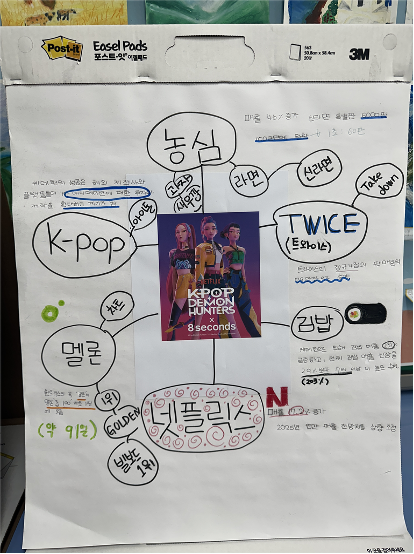 rated benefits for different individuals and institutions. Through a series of activities-including discourse analysis, media ecosystem mapping, role-play-based discussion, and news writing-students organized their perspectives from multiple angles.
Questions Beginning with“Korean Elements”
After the first lesson, which centered mainly on understanding the story, we shifted our attention to Korean cultural elements found in the film. I asked, "What Korean elements did you notice in this film?" Students enthusiastically discussed Korean foods, cultural spaces, symbolic images, and familiar urban settings and fashion. One student shared the following observation: “ It feels like it is trying to introduce Korea to people overseas. I especially related to the scene where a napkin is placed under the chopsticks.” This comment prompted new questions. "Why does the film include so many Korean elements?" Students speculated about the creators’ intentions, particularly in relation to Netflix as a global platform, and grew curious about the invisible structures behind the film.
Media Ecosystem Mapping: The Structure Behind the Story
Next, I asked: “Who was involved in the process of making this story, spreading it, and turning it into a popular success?” As the question was posed, students’ attention shifted beyond the story itself. Through brainstorming, they identif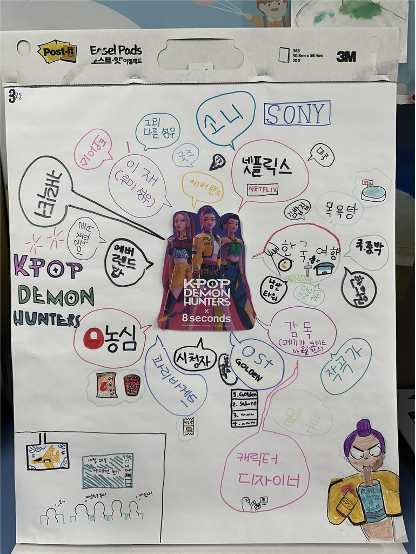 ied directors, writers, voice actors, and music producers, as well as food companies, tourism industries, platforms, and even themselves as viewers. They explored news articles, YouTube videos, and online posts, marking individuals and institutions that appeared repeatedly in discussions of the film’s success. As their inquiry deepened, the ecosystem expanded to include Netflix, Sony Pictures, K-food and K-beauty brands, idol groups, Billboard charts, and theme parks.
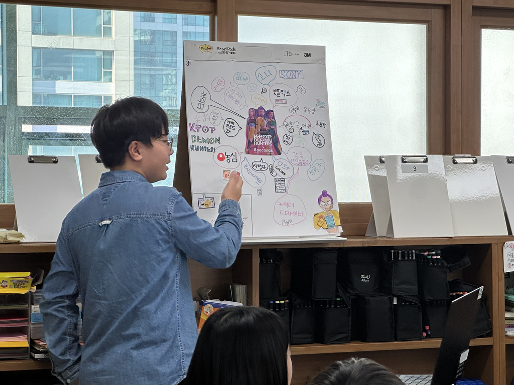
At that point, we closed our laptops and returned to a familiar question: “Who benefited from the popularity of K-pop Demon Hunters?” Students began drawing media ecosystem maps, placing the film at the center and connecting the people and institutions they had identified. Some connections were drawn thick, others thin; some names large, others small. Debates naturally emerged about where benefits flowed most strongly and who remained largely invisible. Through this process, students actively constructed and reorganized the media ecosystem themselves.
Immersion Through Role-Based Dialogue
Following the media ecosystem mapping activity, the moment of greatest excitement and debate came during the role-play-based discussions. In each group, students selected stakeholder roles such as Netflix, Sony Pictures, a local gimbap shop owner, or a voice actor and researched their perspectives before organizing their findings in a shared document. Through this process, students discovered for themselves that benefits were not distributed equally and that imbalances and tensions existed within the media ecosystem.
In playing their roles, students made comments such as:
“Even though the movie was a huge hit, Sony didn’t actually earn that much. Does that make sense?”
“But Sony agreed to the intellectual property contract. The film succeeded thanks to Netflix’s global capital.”
Students defended interests, challenged one another, and negotiated tensions. This dialogue allowed them to view the media ecosystem from multiple perspectives. As a teacher, I simply observed while the conversation unfolded under students’ leadership.
Why These Conversations Matter
The purpose of this lesson was not to criticize a cultural text or teach a correct answer. Rather, I wanted students to recognize the media ecosystems they already participate in not as objects to judge from the outside, but as structures to interpret and question from within. Popular culture is often treated as something students consume simply to take a break. Yet it can serve as a powerful starting point for examining where media, power, and profit intersect. The more familiar a text is, the more willing students are to engage with difficult questions about it.
K-pop Demon Hunters is only one exa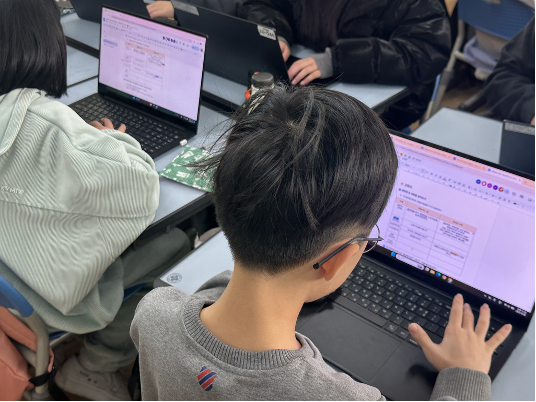 mple. What matters more is creating spaces where students can continue to ask: "Who benefits? And where do I stand within this media ecosystem?"
Rather than positioning students solely as individuals to be protected, I want to engage them as participants capable of questioning and interpreting complex structures. For educators considering similar approaches, it may be enough to begin with a single question. The learning that follows is often deeper than expected.
For readers interested in the real-world economic dynamics raised by students, articles such as “Sony Made Only $20M From Netflix’s K-pop Demon Hunters” offer a compelling glimpse into the power imbalances embedded in contemporary media ecosystems.
Sejin Kim is an elementary school teacher and an Ed.D. candidate in Digital Media Education at Gyeongin National University of Education (GINUE), South Korea. Her research explores how children engage with popular culture and digital media platforms, with a focus on critical media literacy and classroom-based practice.
MediaEd Insights - February 2026 - K-Pop Demon Hunters
Opening Essay: “Is Korea Really Like That?”: Teaching K-Content Literacy in the Age of Global Media by Jiwon Yoon
Review: What K-Pop Demon Hunters Teaches Us About Media Literacy Education by Hyeon-Seon Jeong
Lesson Plan: Good vs. Evil and the Limits of Empathy in K-Pop Demon Hunters by Elizaveta Friesem
Case Study: Who Benefits? K-pop Demon Hunters and the Media Ecosystem by Sejin Kim
Comments(0)