Research Brief | MediaEd Insights | AI: Educator Perspectives Edition | June 2026
Written by Glen Warren
 Artificial intelligence is challenging education, but perhaps not in the ways many of us expected.
Much of the conversation has focused on tools, policies, and skills. How should students use AI? What policies should schools adopt? How do we address academic integrity? What new competencies are now essential?
These are important questions.
Yet as I work with students and educators, I find myself returning to a different set of questions: Who are students becoming through their learning? Why does their learning matter?
AI is surfacing strengths we have long valued and weaknesses we have often overlooked. Most of these did not begin with AI. AI is simply making them harder to ignore.
For decades, education has focused heavily on Scope and Sequence. We devote considerable attention to determining what students should learn and when they should learn it. Standards, curriculum maps, pacing guides, and assessments all support this important work.
This approach has tremendous value. Knowledge matters. Skills matter. Learning should build over time.
But AI is reminding us that education must also attend to People and Purpose.
Students interacting with AI can generate information, ideas, summaries, images, and even polished products within seconds. The central educational questions are no longer simply whether students can produce an answer or complete an assignment. They increasingly become questions of judgment, meaning, relevance, and responsibility. We want learners asking: Why should I trust this? Whose perspective might be missing? Who might be impacted by sharing this information? Why should I care as both a consumer and creator of information?
These are not purely AI literacy questions. They are information literacy questions. They are media literacy questions. Increasingly, they are human questions.
Fortunately, education does not begin this work from scratch. For decades, researchers across information literacy, media literacy, cognitive psychology, and the learning sciences have explored these very challenges. Scholars including Renée Hobbs, Sam Wineburg, Daniel Willingham, John Bransford, David Perkins, and Gavriel Salomon, among many others, have helped us understand how people evaluate information, transfer learning, develop agency, think critically, and apply knowledge in meaningful ways.
AI is not replacing those questions. It is making them more visible and more urgent.
As schools rush to implement AI literacy initiatives, there is a risk of treating AI literacy as something entirely new. I would argue the opposite. Effective AI literacy is built upon decades of research and practice in information literacy, media literacy, and the learning sciences. When those foundations are weak, AI literacy efforts are a house built on sand.
Several frameworks are emerging in response to these questions. One contribution to that conversation is IAM.
IAM — Caring and Curious
A Practical Toolkit for Information, AI, and Media Literacy in a Connected World
IAM is designed to help educators navigate the opportunities and challenges of teaching in the age of AI. Rather than introducing another separate initiative, it serves as a practical toolkit that connects the wisdom of information literacy, AI literacy, media literacy, and the learning sciences into a coherent approach for today’s classrooms.
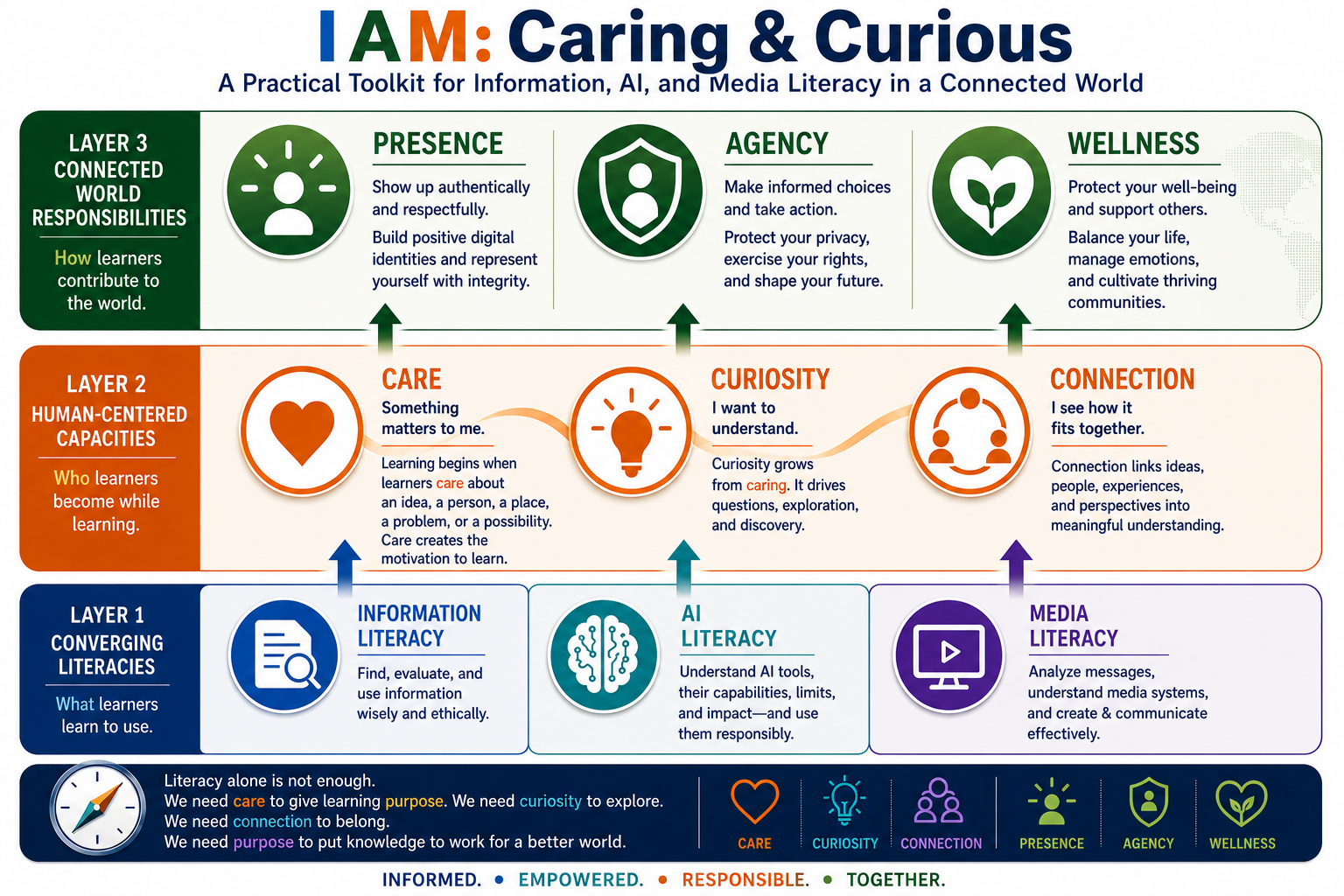
The toolkit provides practical strategies that educators can embed into learning already taking place. It helps students ask meaningful questions, evaluate information thoughtfully, recognize multiple perspectives, consider the impact of their choices, and connect ideas, people, evidence, and systems into coherent understanding. In doing so, it recognizes that literacy alone is not enough. Students also need curiosity to explore, care to consider others, and the capacity to connect knowledge with meaning, responsibility, and purpose.
The future of education will always require Scope and Sequence. But the age of AI reminds us that education must also attend to People and Purpose. Our goal is not simply to help students know more. It is to help them become thoughtful, informed, and responsible people who can use knowledge wisely in a connected world.
Research Spotlight: Three Questions Shaping the Future of AI in Education
As educators explore the opportunities and challenges of AI, researchers across information literacy, media literacy, learning science, and cognitive psychology continue to investigate several enduring questions that are becoming increasingly important in the age of AI.
Does access to information lead to understanding?
Research from scholars including Daniel Willingham, Sam Wineburg, and Renée Hobbs reminds us that access to information does not automatically produce understanding or sound judgment. As AI makes information instantly available, the educational challenge increasingly shifts from finding information to evaluating evidence, recognizing perspective, making connections, and applying knowledge thoughtfully.
Can students transfer learning across contexts?
Learning scientists such as John Bransford, David Perkins, and Gavriel Salomon have spent decades studying transfer, the ability to apply learning in new situations. Their work consistently shows that transfer is difficult. AI may become one of education’s greatest transfer tests, requiring students to apply information literacy, media literacy, critical thinking, and ethical reasoning beyond the lessons in which they were originally taught.
Which human capacities become more important as AI becomes more capable?
As AI performs more cognitive tasks, educators are increasingly asking which qualities become more — not less — essential. Curiosity, judgment, creativity, empathy, civic responsibility, and purpose are emerging as capacities that help learners navigate an increasingly intelligent and connected world. The work of cultivating these capacities — and helping students connect knowledge to meaning and responsibility — remains one of education’s most important challenges.
Across these fields, a common conclusion is emerging: AI is not replacing information literacy or media literacy. It is revealing why both matter more than ever.
MediaEd Insights - June 2026 - AI: Educator Perspectives
Opening Essay: Artificial Intelligence in Educational Settings: Benefits, Challenges, and Concerns by Sarah Eckerstorfer
Case Study: Three Layers of Professional Isolation -- a graduate teaching assistant's experience of grappling with AI use in college classrooms by Salome Apkhazishvili
Case Study: Students' AI Usage in an Introductory Course: Reinforcing the Learning Experience by Caleb Cameron
Curriculum Review: Practicing Perspective Taking in a Polarized Media Environment by Catharine Reznicek
Research Brief: The Educator Experience with AI: Beyond Scope and Sequence by Glen Warren
Comments(0)